Writing Class 6-8 Practice Test for Literature Assessment (2)
Warm-Up for Literature Assessment
Some major assessments test your ability to read and respond to literature.
How Can I Practice for Assessment?
The best way to practice for a reading and writing assessment is to take a practice test, like the one in this unit. You will closely read a story and a poem and write about them. You'll also write a story of your own.
You’ll find a playful story about a girl who tries to get away from her shadow. You’ll also read a poem about a man speaking to his reflection. Read them closely. You’ll be drawing evidence from them to build a response. You’ll also get to experiment with telling a story of your own.
If you would like more help with closely reading literature and responding in writing, see the unit “Reading and Writing Literature for Assessment.”
Responding to a Story for Assessment
When you closely read a story, pay attention to character, setting, conflict, and theme.
Closely read a short story.
Read the following story. You will need to answer questions afterward, but you can refer back as needed.
Source 1
Friend Beneath Your Feet
By Felice Williams
Jana stretched, yawned, and jumped out of bed.
“Ow! Hey! Get off me!”
Startled, Jana jumped back in bed. “Who said that?”
A muffled voice came underneath her. “Me!”
“Who are you?”
“Your shadow, that’s who,” the shadow replied. “I’m pinned underneath you!”
“Sorry!” Jana replied, scrambling off the bed.
“You’re stepping on my feet!” the shadow growled.
Jana lifted her feet, dancing to keep from stepping on the shadow, but every time her foot came down, the shadow was right under it. “Hey, you keep putting your feet under mine!”
“Of course I do. I’m your shadow!”
Jana shook her head. “Then I can’t help stepping on your feet or pinning you to the bed, can I?”
“No, you can’t help it,” her shadow replied, “but at least you could realize you’re doing it. Maybe you wouldn’t stomp around so much if you thought about how you’re always stepping on my feet!”
“Sorry.” Jana crossed her arms and sighed. “So, you’re just going to follow me around all day?”
The shadow also crossed her arms. “That’s my job.”
“Well, try to keep up!”
Jana got dressed quickly, but her shadow also got dressed in shadow clothes. Jana darted down the stairs and through the door, her shadow right on her heels. She jumped on her bike and took off down the sidewalk. Her shadow rode a shadow bike right behind. Jana swerved up next to a chain-link fence, trapping the shadow on the other side. She leaned her bike on the fence and jumped off.
“Ha!” Jana said. “You’re on the wrong side of the fence. As long as I stand right here, you can’t get at me.”
The shadow shook her head. “Sure, for now. The sun is in the east. At noon, the sun will bring me on your side of the fence.”
“Well, maybe at noon, I’ll stand on a sewer grate, and you’ll be trapped down in the sewer,” Jana said.
“Why are you being mean to me?” asked the shadow.
Jana wasn’t sure. “I just don’t want someone following me around.”
The shadow said, “I’ve been with you every day of your life. I’ve just never spoken up before.”
“Well, why did you speak up today?” Jana asked.
“I thought we could be friends,” her shadow replied.
“I’ve already got friends.”
“Okay. When they’re around, I won’t say a word,” said the shadow, “but when they’re not, you can hang around with me.”
Jana didn’t say anything more, getting on her bike and riding to the park. Her shadow followed her, of course. She lost her shadow in the shade for a while, but when she went to the slide, the shadow was right there. It climbed down the shadow ladder while Jana climbed up. When she got to the top, though, she looked down at the shiny metal and saw her reflection. “Is that you, shadow?”
Her reflection smiled. “Yep. I look just like you.”
Jana shrugged. “All right. Let’s slide.”
They slid together, then ran around together, and climbed opposite directions and slid again. Next they played on the swings, swooping close at the bottom and pulling far away at the top. Jana’s shadow smiled at her from the lake, too, and skipped rocks with her, and ran through the tall grass with her. Jana’s shadow did everything that Jana wanted to do, took breaks at the same time, slurped shadow water from the shadow drinking fountain when she was thirsty.
As they sat side by side on a bench, Jana said, “I hardly noticed you before today, shadow, but you are probably my closest friend.”
“Yeah,” her shadow replied. “I know.”
As the sun began to set, Jana’s shadow got longer and longer. Soon, it was twice her height. Then it was three times. “Sorry I’m getting so big,” the shadow said.
“We better get you home.” Jana rode her bike back, cringing as her shadow spilled off the sidewalk and into the street. She kept it from getting run over. At dinner, her shadow was even bigger, hulking there behind her. Mom and Dad didn’t even notice, but Jana could sense her friend crouching silently in the corner.
That night, as Jana lay down in bed, she reached for the light. “Where do you go at night, when I turn off the light?”
“I go everywhere. Night is when I’m free. I’m as big as the world.”
“Well, come back tomorrow,” Jana said, switching off the light.
“Oh, I will,” her shadow replied, already faraway. “I will, friend.”
Teaching Tip
This material simulates the reading and writing that students will do on high stakes assessments. Students who work through these pages will be better prepared for reading and writing literature on these assessments.
Respond to the short story.
Answer these questions to think about character, conflict, and theme. Make a copy of this Google doc or download a Word template.
- Who is the main character of this story?
A. Jana
B. Her shadow
C. Her mom
D. Her dad
- What conflict does the main character face?
A. Person against person
B. Person against society
C. Person against machine
D. All of these
- At the beginning, how does Jana feel toward her shadow?
A. She thinks of her shadow as her closest friend.
B. She feels terrified that her shadow has come to life.
C. She feels surprised and annoyed.
D. She thinks her shadow is entertaining.
- What evidence supports your answer for number 3?
A. Jana gets dressed.
B. Jana tries to escape her shadow by running and riding.
C. Jana traps her shadow on the wrong side of the fence.
D. Both B and C show Jana’s feelings.
- How does Jana feel toward her shadow at the end?
A. She thinks of her shadow as her closest friend.
B. She feels terrified that her shadow has come to life.
C. She feels surprised and annoyed.
D. She thinks her shadow is entertaining.
- What evidence supports your answer to number 5?
A. Jana sees her reflection in the slide.
B. Jana sees her reflection in the lake.
C. Jana tries not to let her shadow get run over.
D. Jana calls her shadow her closest friend and wants it to return.
- In the paragraph about dinner, what does the word “hulking” mean?
A. Powerful
B. Green
C. Big
D. Quiet
- What context clue supports your answer to number 7?
A. “She kept it from getting run over”
B. “her shadow was even bigger”
C. “Mom and Dad didn’t even notice”
D. “crouching silently in the corner”
- How is Jana changed during the course of this story?
A. She learns to put up with her shadow.
B. She learns to never let anyone know that she has a shadow.
C. She recognizes a friend who has always been with her.
D. She learns strategies to stay safe from her shadow.
- What is the writer trying to say about life? (theme)
A. Shadows are our best friends.
B. Shadows run wild at night.
C. People shouldn’t argue with imaginary creatures.
D. People should appreciate those who are always with them.
Responding to a Poem for Assessment
When you closely read a poem on an assessment, pay attention to the sounds of poetry, such as rhythm, alliteration, and repetition. Also note the meaning of poetry, focusing on features like imagery, metaphor, and symbolism.
Closely read a poem.
Read the following poem, paying attention to sound and meaning.
Source 2
Chicago Poet
Carl Sandburg
I saluted a nobody.
I saw him in a looking-glass.
He smiled—so did I.
He crumpled the skin on his forehead,
frowning—so did I.
Everything I did he did.
I said, “Hello, I know you.”
And I was a liar to say so.
Ah, this looking-glass man!
Liar, fool, dreamer, play-actor,
Soldier, dusty drinker of dust—
Ah! he will go with me
Down the dark stairway
When nobody else is looking,
When everybody else is gone.
He locks his elbow in mine,
I lose all—but not him.
Respond to a poem.
Answer these questions, focusing on the poem’s sound and meaning. Make a copy of this Google doc or download a Word template.
- Which are examples of alliteration?
A. “smiled—so” “forehead, frowning”
B. “I was a liar” “dreamer, play-actor”
C. “dusty drinker of dust” “down the dark stairway”
D. Both A and C contain alliteration.
- Which words are repeated in the poem?
A. “saluted”
B. “so did I”
C. “crumpled”
D. “stairway”
- Infer why the poet uses the repetition in number 2.
A. He couldn’t think of a different rhyme.
B. He used repetition to create confusion.
C. He used repetition to create a sense of reflection.
D. He wanted to make strong imagery.
- What imagery describes the poet?
A. “crumpled the skin on his forehead“
B. “Liar, fool, dreamer, play-actor”
C. “Soldier, dusty drinker of dust”
D. All of these describe the writer and his reflection.
- Why does the poet say he is a liar for knowing his own reflection?
A. He hasn’t seen his reflection before.
B. He doesn’t know who he really is.
C. His reflection is too dusty to recognize.
D. He thinks he is seeing a different person.
- What is the poet trying to say about life? (theme)
A. People can’t resist looking at themselves in mirrors.
B. You can’t have a conversation with your reflection.
C. We can never escape who we are, even if we are strangers to ourselves.
D. Mirrors on stairways are dangerous.
Writing an Essay for Assessment
Some tests ask you to write an essay response to short stories and poems you have closely read. The following activity will help you practice.
Analyze an essay prompt.
Read the following prompt, answer the PAST questions about it, write a focus statement, and list details. Make a copy of this Google doc or download a Word template.
Read the writing prompt.
The short story “Friend Beneath Your Feet” tells about a day that Jana spends with her shadow. The poem “Chicago Poet” tells about a poet seeing himself in a mirror. Both deal with reflections and shadows, which stay with us our whole lives. What theme is the same in this short story and this poem? How does the short story express this theme? How does the poem express it? Use evidence from the two sources.
Answer the PAST questions.
Purpose?
Audience?
Subject?
Type?
Write an essay response.
Create an essay that responds to the prompt about the story and poem. Include a beginning paragraph that leads to your focus statement. Write middle paragraphs that support the focus statement with main points and details. Create an ending paragraph that wraps up your ideas. Use details from the sources, giving credit with the title and author’s name.
Revise and edit your essay.
Read your essay and ask yourself the following questions. Correct any problems you find. Make a copy of this Google doc or download a Word template.
- Is my essay on target with the prompt and the PAST questions?
- Do I have a clear focus statement and topic sentences?
- Do I support them clearly with a variety of details?
- Are my beginning, middle, and ending paragraphs effective?
- Have I checked my spelling?
- Are all of my sentences complete (no fragments or run-ons)?
Writing a Story for Assessment
Some tests ask you to write a story of your own, using another story as inspiration. The following activity will help you practice.
Analyze a story prompt.
Read the following prompt and answer the PAST questions about it. Then write down ideas for your story. Make a copy of this Google doc or download a Word template.
Read the writing prompt.
You’ve just read about a shadow and a reflection. Now imagine that you have an adventure with your own shadow or reflection. How do you discover each other? Do you get along? What do you do together? Write a short story that describes your experience with your shadow or reflection. Try to make your story entertaining and original.
Answer the PAST questions.
Purpose?
Audience?
Subject?
Type?
Write an idea for your story.
List questions you have about your idea.
Write a story response.
Create a short story about meeting your shadow or reflection. Include a beginning that introduces the setting, character, and conflict. Then use action, dialogue, and description to build the tension toward a climax. In the end, show what happens after the climax, and how life goes on.
Revise and edit your story.
Read your story and ask yourself the following questions. Correct any problems you find. Make a copy of this Google doc or download a Word template.
- Is my story on target with the prompt and the PAST questions?
- Do I create an interesting main character and conflict?
- Do I use sensory details and dialogue to move the story along?
- Do I bring the action to an exciting climax?
- Have I checked spelling?
- Have I corrected any other errors?
Assessing with an Explanatory Rubric
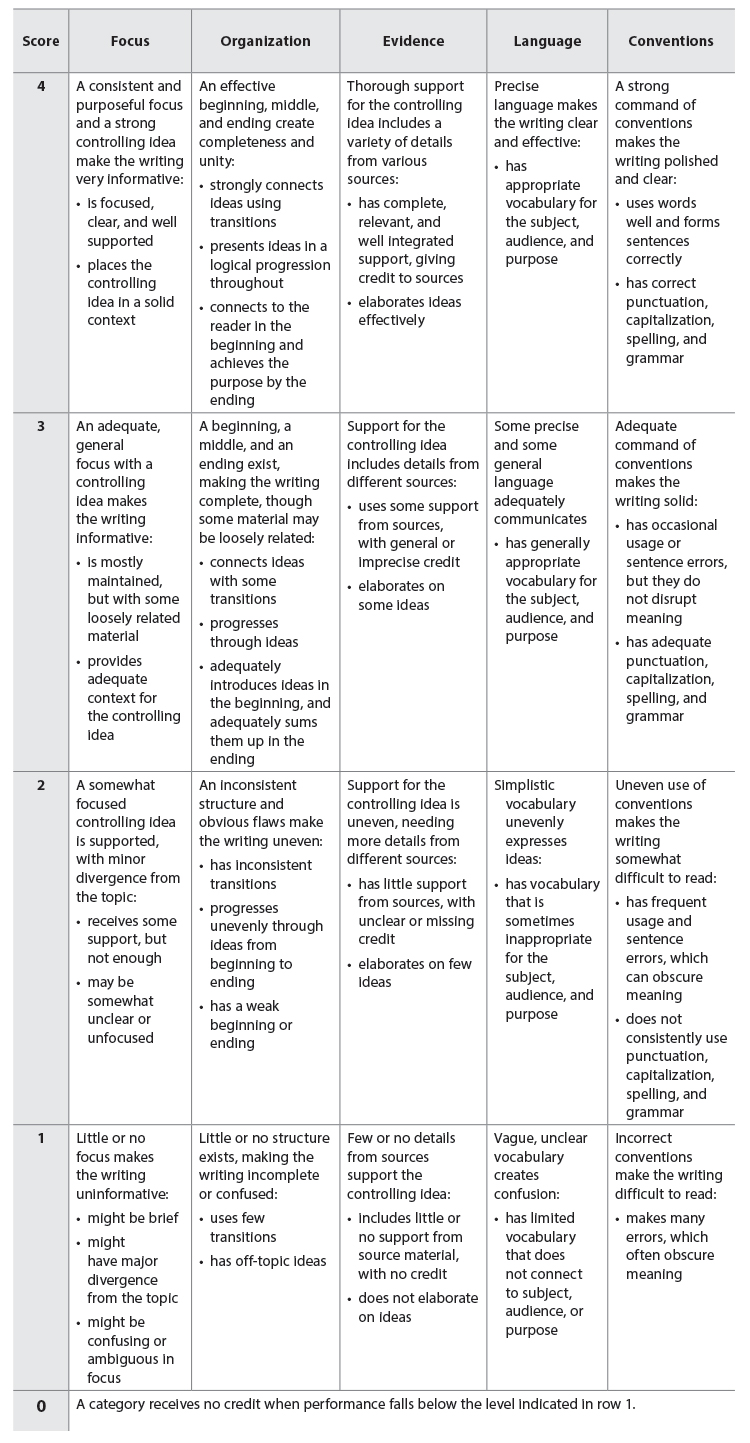
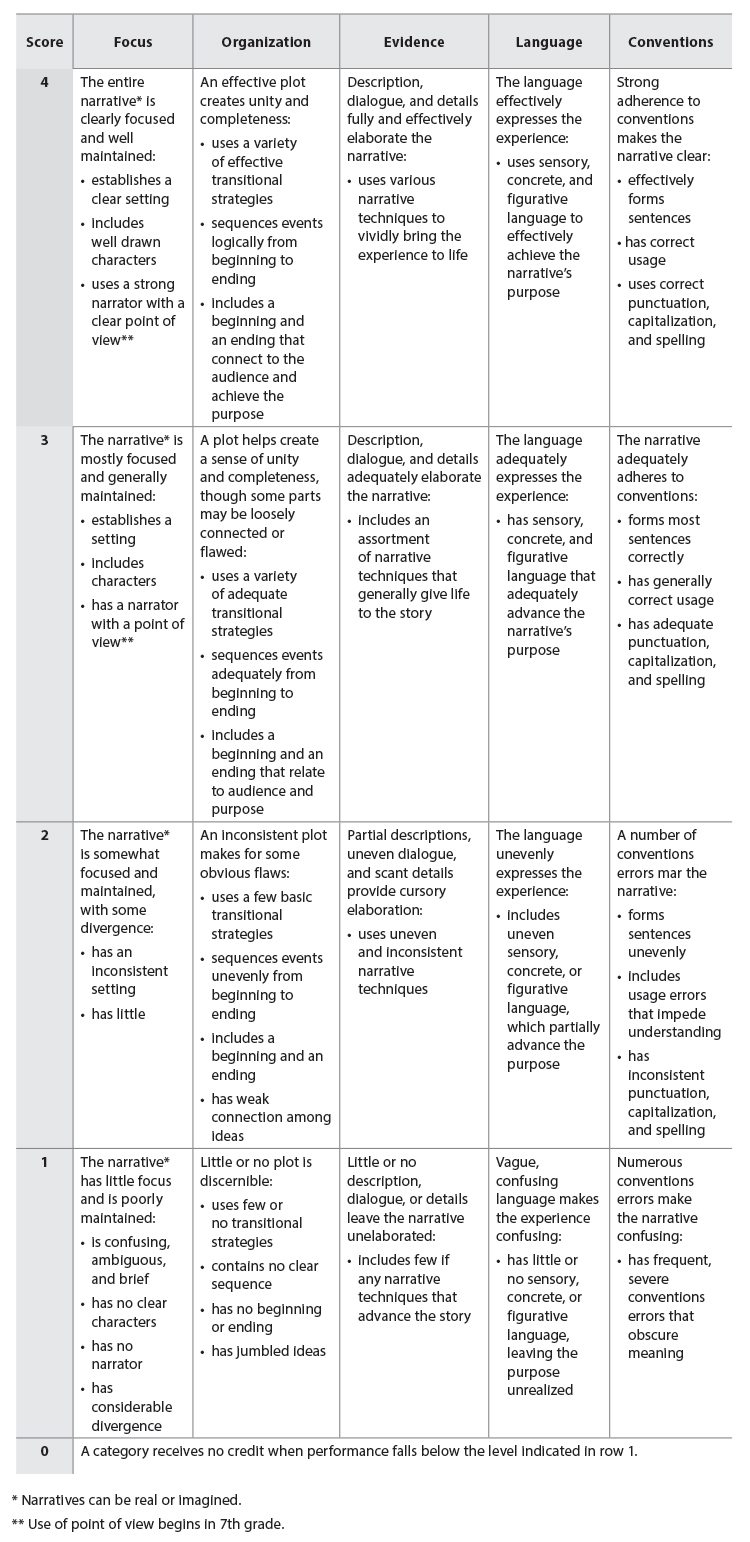
A test grader will use a rubric to score your on-demand writing. A rubric lists the features the grader is looking for at different levels of performance. If you understand the kinds of rubrics that graders use, you will better understand how to write responses that score well. In this lesson, you will see rubrics for explanatory and narrative writing, based on rubrics used for the Common Core State Standards.
Assess with an explanatory rubric.
Use the following rubric to score a literary analysis for assessment. Make a copy of this Google doc or download a Word template.
Assessing with a Narrative Rubric
Assess with a narrative rubric.
Use the following rubric to score a story for assessment. Make a copy of this Google doc or download a Word template.
Comments
Post a Comment