Writing Class 6-8 Reading and Writing for Literature Assessment
Warm-Up for Reading and Writing Literature Assessments
Reading lets you experience great stories, and writing helps you tell your own great stories. That's why some major assessments test your ability to read literature, write about it, and maybe even write your own stories.
What Is Literature Assessment?

Literature assessments test how well you read stories and poems and whether you can write clearly about them. On some literature assessments, you will create your own stories. This unit will help you prepare for these kinds of assessments.
In the following activities, you’ll learn about close reading—reading to understand how a story or poem works. You’ll discover how writers use character, setting, plot, conflict, and theme to develop stories. You’ll also learn how poets use rhythm, rhyme, imagery, and figures of speech. Then you’ll discover strategies for on-demand writing—strategies for developing your own ideas during an assessment.
Thinking About Close Reading
To read closely, you need to think about the parts of a story: character, setting, conflict, and theme. Even flash fiction has these elements.
Read closely.
Read the following flash-fiction story and answer the questions. Make a copy of this Google doc or download a Word template.
Worm with a Backbone
By Kerry Jackson
Flippy the Fish had never seen such a fat worm. It just hung there, wriggling under the water. Its pink skin gleamed with morning sunlight, and the flesh puffed up in the most delicious way. What a perfect breakfast! Flippy was just a little blue gill in a big pond, but if he ate enough worms like this, he’d be a big fish in no time. Except there was something weird about this worm. It was curved. It wriggled, yes, but it never unbent. Flippy moved closer and blinked. The worm looked like it had a backbone—a metal backbone curved in a hook shape. Hmm. Who wants to eat metal? Not so delicious after all, Flippy thought. He finned away across the pond, looking for a better breakfast.
- Who is the main character of this paragraph?
- What is the setting? (List place and time.)
- What does the main character want?
- What is the conflict? (What is the character trying to decide?)
- What would happen if the main character made a different decision?
- What theme does this story have? (What lesson about life does it teach?)
Thinking About On-Demand Writing
To write a flash-fiction story, you need to put a character into a setting, create a conflict, and show what happens.
Create a character, setting, and conflict.
Answer the following questions. Make a copy of this Google doc or download a Word template.
- Who (person or animal) would you like to write a story about?
- Where and when would you like to set your story?
- What struggle will your person or animal face?
Write a flash-fiction story.
Put your character in the setting, create conflict, and show the result.
Closely Reading Stories
To closely read stories, you should read once to get an overall sense of what is happening. Then return to read a second time and focus on character, setting, conflict, and theme.
Read a short story.
Pay close attention to the main character and what he wants.
The Most Sensible Car
By Carolyn Asher
Coup was the most sensible car at the dealership: blue, mid-sized, economical, with a ten-year warranty. . . . He didn’t need to go from 0 to 60 in five seconds like the muscle cars. He didn’t need to carry a family of seven on a three-week jaunt like the vans.
What coup did need was an owner who appreciated practicality.
That woman certainly wouldn’t do—that woman with her spray tan and her five-inch heels.
“Here she comes!” Wheels whispered to Coup. “My new owner!”
The woman reached for Coup’s door handle, but it was locked. Wheels meanwhile flipped his door open.
An hour later, she was driving away in him. A saleswoman pulled Van up where Wheels had been.
Just then, a couple with five kids swarmed into the dealership. Sticky fingers smeared chocolate on Coup’s side. He was glad his door was locked. Van’s was not. In moments, the family was packed inside, rocking the vehicle on her shocks.
“Some people!” Coup remarked.
Van made no comment. An hour later, she was carrying her new family away. A salesman drove Two-Door up to take her place.
“Good luck,” Coup said. “Nobody likes our kind. I’ve been here for months, and nobody ever picks me. It’s just as well. I wouldn’t want most of the people who come here, anyway.”
Two-Door shrugged. “I’d be happy with just about anybody. I want to go places, see the world, do things. I want to be useful! Anything’s better than hanging out here, doing nothing.”
Just then, a balding middle-aged man arrived. He had glasses and a pocket protector. He quietly asked where he could find something “affordable” and “reliable.” He was perfect! The salesperson walked him over between Coup and Two-Door. The man reached out to open Coup.
The door was still locked.
The man opened Two-Door, sat down, turned the key, and smiled.
An hour later, Two-Door drove away with his new owner.
“Nobody wants a truly sensible car these days,” Coup said sadly.
Analyze the reading.
Answer the following questions about the story. Make a copy of this Google doc or download a Word template.
- Who is the main character of the story?
- Where and when does the story take place? (setting)
- What does the main character want?
- What struggle does the main character face? (conflict)
- How does Wheels feel about the tanned woman? How do you know?
- How does Two-Door feel about owners? How do you know?
- Coup does not end up with a new owner. Why?
- What lesson about life does this story seem to show? (theme)
Analyzing Characters
Stories focus on people, animals, or humanlike objects called characters. You can analyze a character by describing the person physically and mentally.
- Name
Coup, the most sensible car at the dealership
- Physical description (gender, age, appearance, health, strength, speed)
He is a new car, “blue, midsized, economical, with a ten-year warranty;” he’s not the fastest, the largest, or the most stylish.
- Mental description (intelligence, personality, confidence, attitude)
He is practical and shy. He knows the kind of owner he wants but rarely sees one. He’s picky. He also seems discouraged and closed off.
- Motivation (what the character wants)
Coup wants to find a practical owner. He wants to be driven away from the dealership, but he seems afraid to let people try him out.
Read for character.
Pay close attention to the main character and what she wants.
Glenda of the Giraffe People
By Leslie Fields
Glenda liked to hang around. Literally. Every recess, she hung from the monkey bars until the line of kids barked her down. Then she would hang from the side braces of the swings. At home, she had a favorite tree to hang from. People called her a monkey because she liked to climb so much, but she didn’t climb. She hung. That’s because she wanted to get taller. Glenda was the shortest girl in the sixth grade.
Every morning, her mother measured her on a giraffe height chart. Glenda had heard that people are tallest in the morning, before gravity crushes them. “How tall today?” Glenda asked, stretching.
“Same as yesterday,” her mother said, “four foot even.”
“I’ll probably have a growth spurt today,” Glenda said cheerily, though she wished for just an eighth inch more. “If I hang out a bit.”
But it was not to be. The rain came down all day, so instead of outdoor recess, everybody had to stay inside. Glenda tried to hang from a coat rack, but the recess lady yelled at her, and she had to sit down for the rest of the recess. She could just feel herself crunching down, shorter.
The rain stopped by the time she got home, so she ran out to hang from her favorite branch. No sooner had she grabbed on, but a stray dog came barking into her yard and ran right toward her. Glenda lifted her feet and wrapped them around the branch. “Go away!”
The dog growled and jumped, nipping at her back.
Glenda scrambled up onto the branch. Still the stray jumped at her, its teeth flashing white. Glenda climbed higher to get her feet away. “Stupid dog! Find somebody taller to attack!”
She scrambled higher. He couldn’t reach her now. Glenda looked out. She was already above her neighbor’s garage. Two branches up, and she could see over the roof. Higher still, and she could see over the houses. So that’s what a giraffe felt like!
“I can’t make myself grow,” Glenda said, “but I can sure climb.”
After ten minutes, the dog wandered off, but Glenda stayed at the top of the tree. She wasn’t a hanger anymore. Now she was a climber.
It didn’t matter how tall she was, only how far she climbed.
Analyze the main character.
Describe the main character of “Glenda of the Giraffe People.” Make a copy of this Google doc or download a Word template.
- Name
- Physical description (gender, age, appearance, health, strength, speed)
- Mental description (intelligence, personality, confidence, attitude)
- Motivation (what the character wants)
Analyzing Conflict
Once you know what a character wants, you can think about the obstacles in the way—what the person has to overcome. Obstacles create conflict. You’ll find six basic types of conflict:
- Person versus self means the character is his or her own worst enemy or is struggling to make up his or her mind.
- Person versus person pits the character against another character.
- Person versus society brings the character into conflict with what other people want or think is okay.
- Person versus nature has the person fight weather, animals, wilderness, natural disaster, or forces like aging or gravity.
- Person versus supernatural sets the character against fate or magic.
- Person versus machine pits the character against computers or technology.
Analyze conflict.
Identify the type of conflict in the three stories you have read. Make a copy of this Google doc or download a Word template.
- What is the main conflict in “Glenda of the Giraffe People”? Explain.
- What is the main conflict in “The Most Sensible Car”? Explain.
- What is the main conflict in “Worm with a Backbone”? Explain.
Analyzing Plot
The plot of a story takes a standard shape. The beginning (exposition) introduces character, setting, and conflict. The middle (rising action) raises the level of conflict to a high point (climax). The ending tells what happens afterward (falling action and resolution).
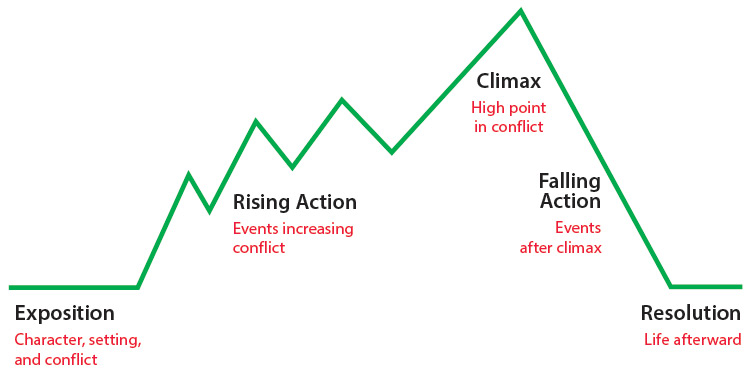
Analyze plot.
Identify the plot in “Glenda of the Giraffe People.” Make a copy of this Google doc or download a Word template.
- What happens in the rising action of “Glenda of the Giraffe People”?
- What happens in the climax of “Glenda of the Giraffe People”?
- How is life different for Glenda afterward?
Analyzing Theme
The theme of a story is a lesson it teaches about life. The theme usually will not be stated outright. You have to infer it from the characters’ actions and words. Ask yourself questions like these.
- What does the main character learn?
Glenda learns that she should focus on what she can control (how high she climbs) rather than what she can’t (how tall she is).
- How does the main character change?
Glenda stops being a hanger and becomes a climber. She accepts her height and focuses on things she can do instead.
- How are you changed by reading this story?
I realize I should accept things I can’t change about myself and focus on what I can do.
- What is the writer trying to say about life? (theme)
Don’t focus on what you are given, but on what you do with it.
Read for theme.
Read the following story, watching for theme.
Finding Your Instrument
By Tom Diesel
"We’re all going to learn saxophone!” Denny said. “A quartet!”
Jamal smiled. Yeah. It would be sweet. He always wanted to learn an instrument, and if his friends took saxophone, he guessed he would, too.
“Come over here, guys,” Denny said, directing the four of them to the front of the auditorium. Instruments lay in their cases, the saxophone gleaming like gold in blue velvet. “Look at that beauty! All the cool people play saxophone.”
“Would you like to try it?” asked Mrs. Sohn, the band teacher.
“Of course!” Denny said. He grabbed the instrument and blew on the mouthpiece. It let out a round tone. Denny pressed keys, and the pitch changed. “Hey! I’m a natural!” He strutted like a jazz man.
“Can I try?” asked Jamal. Denny wiped off the mouthpiece and handed the instrument over. Jamal blew, but the sax only hissed.
Mrs. Sohn said, “Press your teeth lightly on the reed, here.”
Jamal tried again. The sax honked ridiculously.
Denny laughed. “You sound like a goose! Hiss! Honk! Spit! Ha ha! You’re going to be last chair sax—that’s for sure.”
“Last chair?” Jamal asked.
“We compete,” Denny said, taking the sax and handing it to another friend. “Whoever’s best gets first chair. Whoever’s worst gets last.”
Jamal nodded, listening to his friends try. Some sounded as ridiculous as him, but they all still made fun of him.
Jamal stepped to the next case. It held a golden twist of tubes with a big, beautiful bell and a long slide.
“It’s called a trombone,” Mrs. Sohn said. “You blow here, making your lips flutter.”
Jamal tried. Right off, a great tone came out.
“We need trombones,” Mrs. Sohn said, smiling.
Denny came over. “What are you doing? We’re all playing saxes.”
“Good for you.” Jamal played another note. “I’m playing trombone.”
Analyze theme.
Answer the following questions and infer a theme. Make a copy of this Google doc or download a Word template.
- What does the main character learn?
- How does the main character change?
- How are you changed by reading this story?
- What is the writer trying to say about life? (theme)
Analyzing the Sound of Poetry
As you know, a poem is not the same as a short story or a novel. One big difference is that poetry plays with the sounds of words. Different techniques create different sounds. When you read a poem, listen for these kinds of sounds.
Closely read a poem.
Read the following wintry poem, focusing on the sounds it creates.
Winter Time
Robert Lewis Stevenson
Late lies the wintry sun a-bed,
A frosty, fiery sleepy-head;
Blinks but an hour or two; and then,
A blood-red orange, sets again.
Before the stars have left the skies,
At morning in the dark I rise;
And shivering in my nakedness,
By the cold candle, bathe and dress.
Close by the jolly fire I sit,
To warm my frozen bones a bit;
Or with a reindeer-sled, explore
The colder countries round the door.
When to go out, my nurse doth wrap
Me in my comforter and cap,
The cold wind burns my face, and blows
Its frosty pepper up my nose.
Black are my steps on silver sod;
Thick blows my frosty breath abroad;
And tree and house, and hill and lake,
Are frosted like a wedding-cake.
Analyze poetry sounds.
Write down examples of each type of sound from "Winter Time" by Robert Lewis Stevenson. (Sample answers are provided for each.) Make a copy of this Google doc or download a Word template.
- Alliteration
“Late lies”, “frosty, fiery”
- Assonance
“red/sets”
- Onomatopoeia
“blinks”
- Repetition
“blow/blows”
- Rhyme
“bed/head”, “then/again”
- Rhythm (underline stressed syllables)And tree and house, and hill and lake,Are frosted like a wedding-cake.
Analyzing the Meaning of Poetry
Poetry uses different techniques to create different meanings. When you read a poem, watch for these kinds of techniques.
Closely read a poem.
Closely read the following poem, paying attention to how the writer uses connotation, denotation, and other special techniques to create meaning.
Robin Redbreast
William Allingham
Goodbye, goodbye to Summer!
For Summer’s nearly done;
The garden smiling faintly,
Cool breezes in the sun;
Our Thrushes now are silent,
Our Swallows flown away—
But Robin’s here, in coat of brown,
With ruddy breast-knot gay.
Robin, Robin Redbreast,
O Robin dear!
Robin singing sweetly
In the falling of the year.
Bright yellow, red, and orange,
The leaves come down in hosts;
The trees are Indian Princes,
But soon they’ll turn to Ghosts;
The leathery pears and apples
Hang russet on the bough,
It’s Autumn, Autumn, Autumn late,
“Twill soon be winter now.
Robin, Robin Redbreast,
O Robin dear!
And what will this poor Robin do?
For pinching days are near.
The fireside for the Cricket,
The wheatsack for the Mouse,
When trembling night-winds whistle
And moan all round the house;
The frosty ways like iron,
The branches plumed with snow—
Alas! in Winter, dead, and dark,
Where can poor Robin go?
Robin, Robin Redbreast,
O Robin dear!
And a crumb of bread for Robin,
His little heart to cheer.
Analyze the poem for meaning.
Analyze the meaning of "Robin Redbreast" by William Allingham by answering the following questions. Make a copy of this Google doc or download a Word template.
- What is the connotation of “Cool breezes in the sun”?
- What imagery describes Robin?
- What metaphors describe the trees?
- What is the connotation of “pinching days”?
- What simile using “like” appears in the last part?
- What do you think Robin symbolizes?
Using Evidence from Sources
Whenever you use ideas from a source, you need to name the source and the author. Usually, you put the ideas in your own words (paraphrase them).
Glenda of the Giraffe People
By Leslie Fields
Glenda liked to hang around. Literally. Every recess, she hung from the monkey bars until the line of kids barked her down. Then she would hang from the side braces of the swings. At home, she . . .
In the story “Glenda of the Giraffe People,” Leslie Fields (Title and Author) shows a student who hangs from monkey bars and trees to stretch. . . . (Paraphrase)
If you use the writer’s exact words, put the words in quotation marks. If the quotation is followed by a comma or period, put it inside the end quotation mark.
In the story “Glenda of the Giraffe People,” Leslie Fields (Title and Author) shows a student who “likes to hang around. Literally.” (Quotation) Glenda wants . . .
Paraphrase and quote.
Paraphrase and quote the selection. Credit the title and author. Make a copy of this Google doc or download a Word template.
Robin Redbreast
William Allingham
Goodbye, goodbye to Summer!
For Summer’s nearly done;
The garden smiling faintly,
Cool breezes in the sun . . .
Our Thrushes now are silent,
Our Swallows flown away—
But Robin’s here, in coat of brown,
With ruddy breast-knot gay.
- Write a paraphrase, crediting the title and author.
- Write a quotation from the poem, giving credit.
Analyzing Writing Prompts
Often tests contain writing prompts that you must respond to. Your first step is to understand the writing prompt. Use the PAST questions.
- Purpose? Why am I writing? (To analyze? To entertain?)
- Audience? Who will read my writing? (Tester? Classmates?)
- Subject? What subject should I write about? (Story? Poem?)
- Type? What type of writing should I create? (Essay? Story?)
Sample Writing Prompt
In “The Most Sensible Car” by Carolyn Asher, Coup is looking for a practical owner. In the end, Coup says, “Nobody wants a truly sensible car these days.” Is he right? What evidence from the story supports your conclusion. Write an essay explaining Coup’s problem with finding an owner, and show what the story says about life.
Answers to PAST Questions
- Purpose?
Explain Coup’s problem with finding an owner and show what the story says about life
- Audience?
Any other reader
- Subject?
“The Most Sensible Car” by Carolyn Asher
- Type?
Essay
Note: Some writing prompts do not answer all of the PAST questions. If an answer is not given, infer one (come up with a reasonable answer based on the rest of the information).
Analyze writing prompts.
Read each writing prompt that follows. Answer the PAST questions about it. If the prompt doesn’t answer a question, infer an answer. Make a copy of this Google doc or download a Word template.
In “Glenda of the Giraffe People” by Leslie Fields, Glenda works hard to grow taller. A mean dog changes her ideas. How does Glenda change? What kind of hard work will she do in the future? Write an essay using evidence to explain what Glenda learns.
- Purpose?
- Audience?
- Subject?
- Type?
Robert Lewis Stevenson’s poem “Winter Time” uses strong imagery to capture the feeling of winter. What imagery is your favorite? How does it make you think of winter? Write an essay that examines the imagery and sounds in the poem “Winter Time.”
- Purpose?
- Audience?
- Subject?
- Type?
In his poem “Robin Redbreast,” William Allingham describes how a bird adjusts to the end of summer and the coming of winter. What similes, metaphors, and symbols does he use? Write an essay that identifies the figures of speech and shows how they add to the ideas.
- Purpose?
- Audience?
- Subject?
- Type?
Writing On-Demand Essays
A writing assessment gives you a short time to write a paragraph or an essay. To do so, you should use a shortened form of the writing process.
Prewriting (5 Minutes)
Start by reading the writing prompt and analyzing it using the PAST questions.
Sample Writing Prompt
In “Finding Your Instrument” by Tom Diesel, Jamal and his friends are trying to decide what instrument they would like to play. Denny and the others choose saxophone, but Jamal decides on trombone. Why? What motivates Jamal's decision? Write an essay that explains Jamal's choice, using evidence from the source to support your explanation.
Answer the PAST questions.
Purpose? Explain Jamal’s choice
Audience? Tester
Subject? “Finding Your Instrument”
Type? Essay
Write a focus statement.
Jamal realizes he’s better off choosing his own way.
List supporting details.
--Denny is pressuring everyone to play saxophone.
--Denny makes fun of Jamal.
--Jamal tries trombone.
Writing (Most Time)
Write a beginning that leads to the focus statement.
Sometimes it’s worse to fit in than not to fit in. That’s especially true when you have to fit in by not being yourself. That’s what Jamal learns in “Finding Your Own Instrument” by Tom Diesel. Despite pressure from the group’s leader, Jamal chooses his own way.
Write middle paragraphs to develop each supporting point.
Denny has decided right away what instrument everybody is going to learn. He imagines they’ll all play together in a saxophone quartet. . . .
Write an ending to wrap up the essay.
By choosing trombone, Jamal shows that he is his own person. He figures real friends will accept him as he is, not try to change him. . . .
Revising and Editing (5 Minutes)
Add, cut, rewrite, and rearrange to fix errors.

Respond to a writing prompt.
Read the writing prompt that follows and create an essay response. Make a copy of this Google doc or download a Word template.
In "The Most Sensible Car," by Carolyn Asher, poor Coup can't seem to get anyone to buy him. What is going on? What are the causes of Coup's state? Analyze Coup as a character and use your analysis to explain the conflict that he faces. Use evidence from the short story to support your position. Finally, give Coup some advice to help him find happiness.
Comments
Post a Comment