Writing Class 6-8 Writing Application Letters (5)
Warm-Up for Application Letters
When applying for a job or other opportunity, you'll often be asked to write an application letter. In such a letter, you reveal your goals, qualifications, and skills. This unit will show you how to write a winning letter.
What Is an Application Letter?

What happens when you meet someone new? You probably tell the person your name and a few details about yourself. Next, you might talk about common interests. If the two of you become friends, you will learn more about each other over time.
Sometimes, it’s important to tell key details about yourself right away. For example, if you want to spend a week at soccer camp or volunteer at the local animal shelter, you may need to write a special letter to introduce yourself and make your request. This type of business letter is called a letter of application.
In an application letter, you give information about yourself and tell your reasons for applying for something. When writing your letter, be sure to state all of your ideas clearly and politely. If you do, you will make a good first impression, which is very important.
Thinking About Your Strengths and Weaknesses
Before you can write your letter of application, you should evaluate which skills and qualities you have and which ones you still need to work on. Here's how one student took stock of her skills.
Things I Do Well
Things I Need to Work On
Evaluate your strengths and weaknesses.
For each category below, identify things that you do well and things you need to work on. There is no right or wrong answer in this activity. Your goal is simply to evaluate your skills and abilities. Make a copy of this Google doc or download a Word template.
Things I Do Well
Things I Need to Work On


Prewriting for Application Letters
Prewriting is your first step in writing an application letter. These activities will help you select a topic, gather and organize important details, and review the key parts of business letters.
Prewriting to Find the Right Opportunity
Review opportunities.
What follows are two example advertisements. Review the ads by clicking the arrows and consider how you would respond to them in an application letter. Pick one ad to respond to and list three reasons why you would be a good candidate for the opportunity. Make a copy of this Google doc or download a Word template.
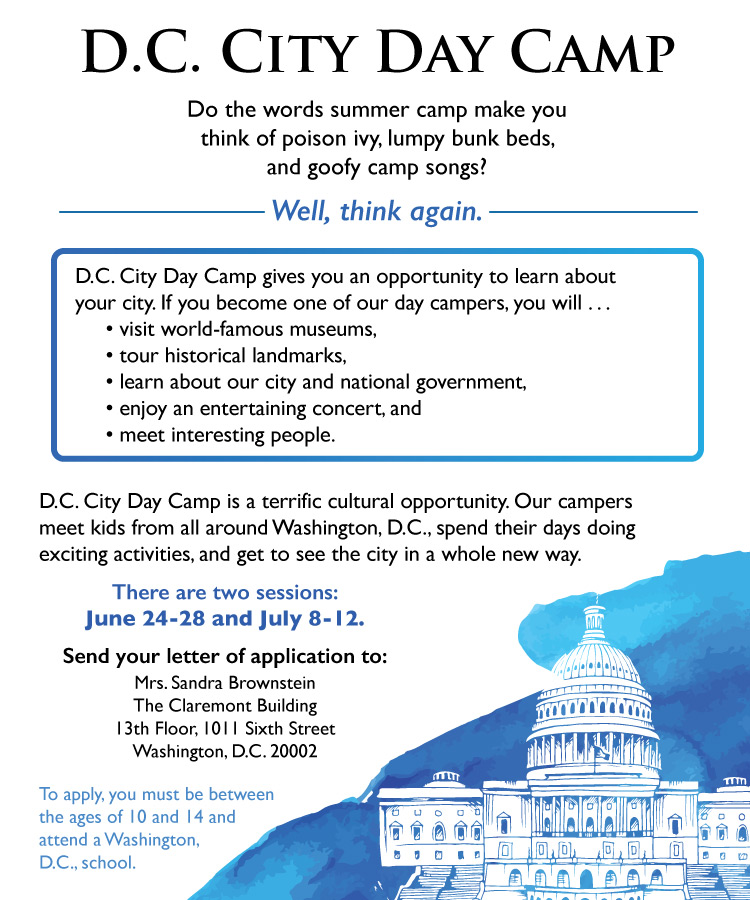

Name of opportunity:
Three reasons why you're a good fit:
Choose an opportunity or job for your response.
Is there an organization or a group that offers an opportunity that interests you? Are you a good candidate for this opportunity? Search for a job or other opportunity you would like to apply for. Record the key details about the opportunity. As an alternative, take a picture or photocopy the announcement. Make a copy of this Google doc or download a Word template.
Is there an organization or a group that offers an opportunity that interests you? Are you a good candidate for this opportunity? Search for a job or other opportunity you would like to apply for. Record the key details about the opportunity. As an alternative, take a picture or photocopy the announcement. Make a copy of this Google doc or download a Word template.
Prewriting to Gather and Organize Details
An effective letter of application is well planned. You must decide what to say and organize the details in a way that will convince your reader to grant your request.
Gather details for your letter.
Follow the steps listed below to gather and organize the details for your letter. Make a copy of this Google doc or download a Word template.
Step 1 Identify what you are applying for (for example, a position as a volunteer or an opening at a camp) and what you know about it.
Step 2 List important information about yourself, including your age, grade level, skills, and interests.
Step 3 Tell why you are a good match for the opportunity. (Give at least three reasons.)
Prewriting to Review the Parts of a Business Letter
A letter of application is a type of business letter. It includes the following parts:
- Heading The heading includes your address and the date you wrote the letter. Write the heading in the upper left-hand corner.
- Inside Address The inside address gives the reader’s name and address.
- Salutation The salutation is the way you politely say hello to the receiver of your letter. It usually begins with the word “Dear” and is followed by the person’s title and last name and a colon.
- Body The body of the letter contains the thoughts and ideas you want to share. Include one main idea in each paragraph to make your letter clear and easy to read. Skip a line between each paragraph of the body. Do not indent the paragraphs.
- Closing The closing is the way to say good-bye politely. Skip a line and write the closing below the last paragraph. “Sincerely” and “Sincerely yours” are common closings. Capitalize only the first word. Follow the closing with a comma.
- Signature The signature is the last part of the letter. Write it below the closing. Use both your first and last names. Leave four spaces after the closing, then type your name. (Write your signature between the closing and the typed name.)
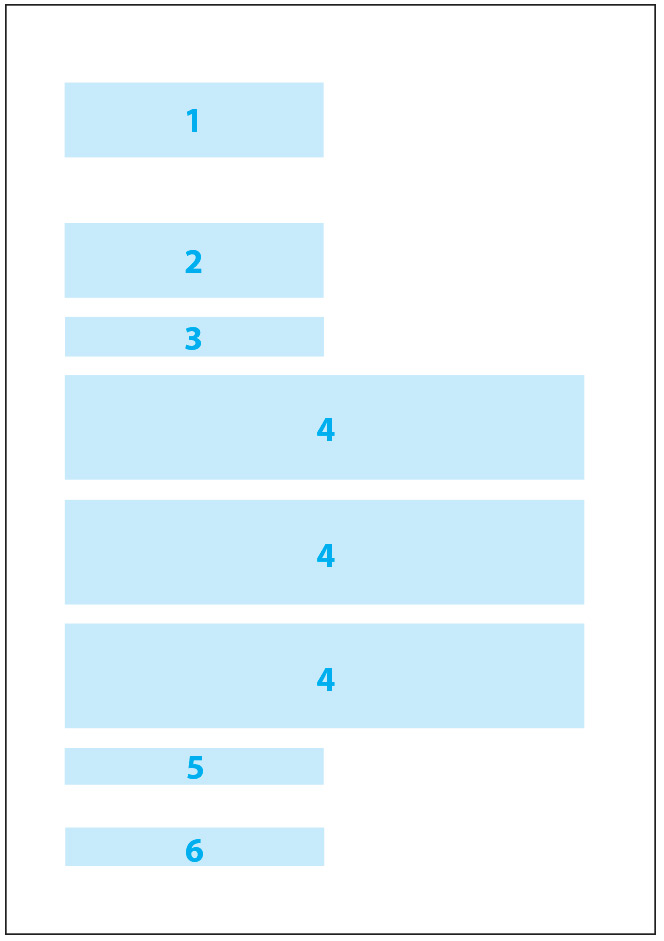
Create your heading, inside address, and salutation.
Follow the instructions to record the first key parts of your letter. First, write your mailing address in the heading. Then record the inside address of the reader or organization you are applying to. Finally, write your salutation. Make a copy of this Google doc or download a Word template.
- Heading: Write your mailing address and the current date on three separate lines.
- Inside Address: Write the inside address of the name, organization title, and address of your reader.
- Salutation: Write your polite greeting to the reader, beginning with the word "Dear."

Writing an Application Letter
Once you finish prewriting, you are ready to write the body of your letter. These activities will help write strong opening, middle, and ending parts.
Writing the Opening Part
Write your opening part.
Read about opening strategies. Then use them to write the beginning of your letter of application. Make a copy of this Google doc or download a Word template.
In the first part of your letter, you should do two things.
- Identify the position that you are applying for.
I am interested in going to SeaScapes Scuba Camp this summer.
- Tell what you know about the organization, such as where you learned about it.
I read about your camp in the most recent issue of Scuba Kidz magazine. I understand that your camp is for kids aged 10 to 16 with all different levels of experience.
Opening Paragraph
Writing the Middle Part
Write your middle part.
Read about middle strategies. Then use them to write the middle part of your letter. Make a copy of this Google doc or download a Word template.
In the middle part of your letter, give information about yourself and explain why you are a good match for the group or organization.
- Give details that the reader will want to know about you, such as your age and your interests.
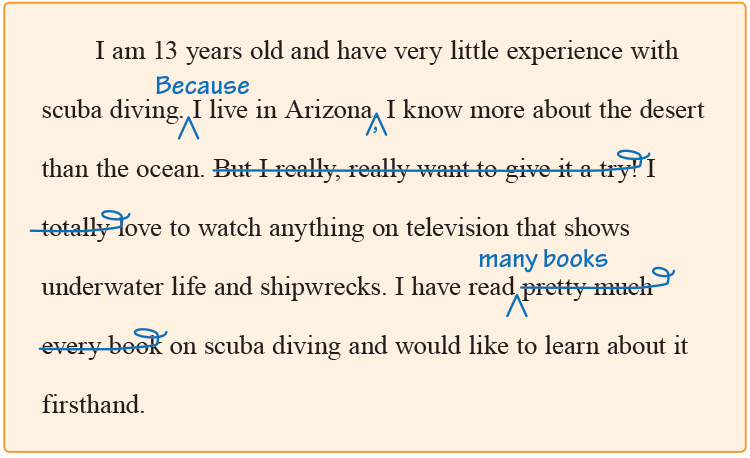
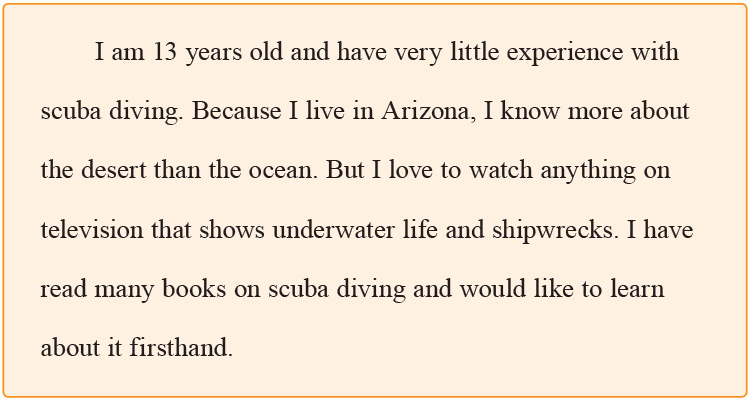
I am 13 years old and have very little experience with scuba diving. Because I live in Arizona, I know more about the desert than the ocean. But I love to watch anything on television that shows underwater life and shipwrecks. I have read many books on scuba diving and would like to learn about it firsthand.
- Give reasons that show you are a good match for the opportunity.
I think that spending the summer at your camp would be a great experience for me. I have never traveled outside my home state and have never seen the Pacific Ocean except on YouTube videos. This would be a great chance to do both. I would also enjoy meeting kids from all over the country. Finally, I think that I might like to become a scientist who studies sea life. Spending the summer at your camp would really help me decide whether that is a good choice for me.
Middle Paragraphs
Writing the Ending Part
Write your ending part.
Read about ending strategies. Then use them to write the end of your letter. Make a copy of this Google doc or download a Word template.
Use the ending paragraph to make a good final impression. Be polite and thank the reader.
- Include any last details.
My science teacher thinks that I would really benefit from your camp. She would be willing to write a letter to show her support.
- Thank the reader.
Thank you for reading my letter.
- Let the reader know that you would like a response to your letter.
I hope to hear from you soon.
Ending Paragraph
Reading an Application Letter Draft
Read a draft of an application letter.
Note how the writer put the parts together.
42 Bellevue Drive, Apartment 12D
Phoenix, AZ 85001
March 21, 2017
Mr. Richard Friedman
Seascapes Scuba Camp
San Diego, CA 92101
Dear Mr. Friedman:
OpeningI am interested in going to your camp this summer. I read about SeaScapes Scuba Camp in the most recent issue of Scuba Kidz magazine. I understand that your camp is for kids aged 10 to 16 with all different levels of experience.
MiddleI am 13 years old and have very little experience with scuba diving. Because I live in Arizona, I know more about the desert than the ocean. But I love to watch anything on television that shows underwater life and shipwrecks. I have read many books on scuba diving and would like to learn about it firsthand.
I think that spending the summer at your camp would be a great experience for me. I have never traveled outside my home state and have never seen the Pacific Ocean except on YouTube videos. This would be a great chance to do both. I would also enjoy meeting kids from all over the country. Finally, I think that I might like to become a scientist who studies sea life. Spending the summer at your camp would really help me decide whether that is a good choice for me.
Ending
My science teacher thinks that I would really benefit from your camp. She would be willing to write a letter to show her support.
Thank you for reading my letter. I hope to hear from you soon.
Sincerely,
Brian Spencer
Brian Spencer

Revising Application Letters
Once you finish a first draft of your application letter, set it aside for awhile. When you return to it, you can see it with a fresh perspective. When you revise, you look at your essay from your reader's point of view to make sure your writing includes a proper tone and effective details. These activities will help you revise.
Revising for Level of Interest
In a letter of application, you should express a clear interest in a special opportunity. To show the proper level of interest, share what you know about the opportunity and give details about yourself. However, too much contrived enthusiasm or too little interest will reflect poorly on you. The following passages come from a letter of application to an elite soccer camp. Each shows a different level of interest.
Sample 1
I saw the ad for your camp. I thought about being a goalie. Maybe I could come to your camp.
(The writer does not sound interested and does not include specific details.)
Sample 2
I would really, truly love to come to your terrific camp. I have heard so much about it from all my friends and would be so honored if I could come. Soccer is my life. Your camp could help me so much. Please, please consider me for a spot at your camp.
(This writer sounds a little too excited and doesn’t include specific details.)
Sample 3
I am applying for a spot at Super Forwards Summer Camp. Your camp was recommended by my coach. I have been playing soccer since I was three. I am a good goal scorer, but I need to develop new moves. I'd like to learn to use my left foot more effectively. Please consider me for your camp.
(This writer sounds genuinely interested. He or she gives personal details and a reason for wanting to go to the camp.)
Check the level of interest.
Read the following passages from letters of application. If the writer seems uninterested or too excited, underline or highlight the passage. If the writer shows the proper interest, leave the passage alone. Next, choose one of the selections you underlined, and rewrite it to show a proper level of interest. Make a copy of this Google doc or download a Word template.
- My coach thinks that Runner’s Camp would really help my speed. I'm applying because he told me to.
- I am a city kid who is totally freaked out by spiders. So I think it would be awesome if I could go to your camp. You could teach me how to deal with scary animals. That would be so great. My mother wouldn’t have to catch all the spiders in the house anymore. Thanks!
- Please consider me for a spot at Green Kids Camp. Even though I live in the city, I know that people need to learn more about the environment. I would bring my camp experiences back to the city in the fall and share them with my friends and classmates.
- This is an application for a place at your computer camp. My dad says that knowing about computers is the key to getting a good job later. I guess I could learn about computers. Maybe your camp would help.
- Please let me volunteer at your day care center! I really love kids! They are so much fun. I would really love to work at your day care center and learn as much as I can! Thanks a bunch!
- I would like to attend the Young Artists Camp this summer. Painting is one way that I feel I can express myself. My goal is to become an artist. I believe that your camp would help me reach my goal. Please consider my application.
Revised Passage
Revising for Sentence Style
Too many short sentences in a row can make your writing sound choppy. You can combine simple sentences into one complex sentence to make your writing flow more smoothly. A subordinate conjunction is one type of connecting word or phrase that is used to create complex sentences. Words like after, when, since, because, while, and before are examples of subordinate conjunctions.
Short sentences:
Parnell was elected team captain. He leads by example.
Combined sentence:
Parnell was elected team captain because he leads by example.
(The two simple sentences are combined into a complex sentence using the connecting word “because.”)
Create complex sentences.
Combine the following sets of short sentences into complex sentences. Use the word or phrase in parentheses to connect your sentences. The connecting word can come at the beginning or in the middle of a complex sentence. The first two have been done for you. Make a copy of this Google doc or download a Word template.
Note: Insert a comma after the first part of a complex sentence if the connecting word comes at the beginning of the sentence. (See the second sentence below.)
- Toshi makes jewelry. She has some free time. (whenever)
Toshi makes jewelry whenever she has some free time.
- Paulo ate lunch. There were three phone calls. (while)
While Paulo ate lunch, there were three phone calls.
- Candice filled her basketball with air. She shot baskets. (before)
- Theo walked home. He found his wallet. (when)
- You’ve finished the assignment. You’re not ready for the test. (unless)
- It rained for an hour. Our baseball game will be played. (although)
- We went to Chris’s house. We played video games. (after)
- You finish your work early. You can go to the city pool. (if)
- I will help you with your assignment. You pay attention. (as long as)
- Taisha checked on the cookies. She returned to her homework. (before)
- Kristos mowed the lawn. Ravi trimmed the bushes. (while)
- Bianca wished she could hide. She was so embarrassed. (because)
Revising with a Peer Response
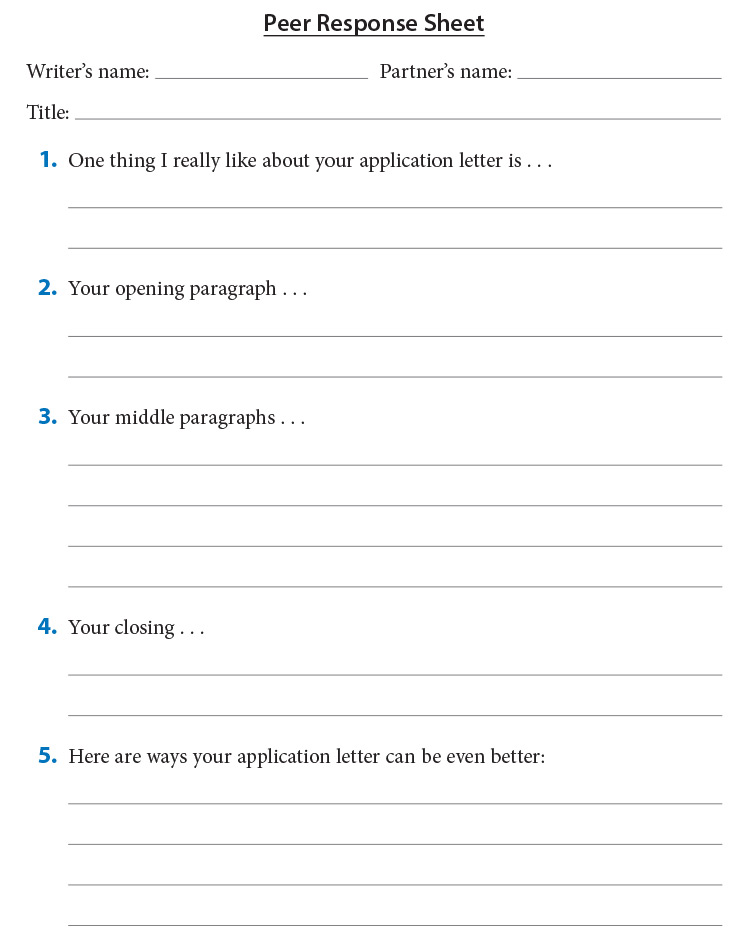
Share your writing.
Have a trusted classmate read your letter and complete the form. Make a copy of this Google doc or download a Word template.
Revising in Action
When you revise, you add, delete, rewrite, and rearrange your writing to make it clearer. Here are some revisions to the application letter to SeaScapes Scuba Camp.
Paragraph Before Revisions
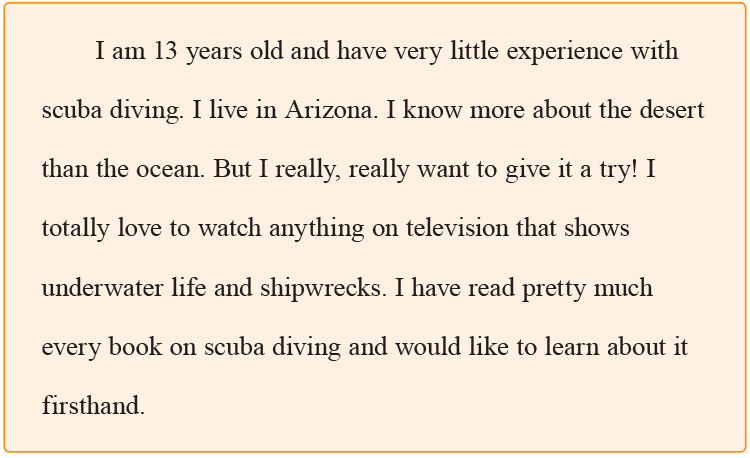
A usage error is fixed and a command sentence is created.
Paragraph After Revisions
Revise with a checklist.
Read each line. When you can answer each question with a yes, check it off. Make a copy of this Google doc or download a Word template.
Ideas
- Does the letter clearly state your intentions?
- Does it express why you are qualified for the position?
Organization
- Does the beginning identify what you are applying for?
- Does the middle include key details about you?
- Does the middle also give reasons that explain why the reader should grant your request?
- Does the ending thank the reader and express hope for a response?
Voice
- Does the whole letter show a proper level of interest?
Word Choice
- Do I use specific nouns and verbs?
- Do my words reflect the formality (seriousness) of the request?
Sentence Style
- Do my sentences flow smoothly?
- Did I combine short, choppy sentences?

Editing Application Letters
To make a great impression, your letter needs to be free of careless errors. Misspelled names, missing end punctuation, or sloppy design could derail an otherwise great letter. The following editing activities will help you create a neat and clean final version of your letter.
Editing Special Parts of a Letter
When checking a business letter for punctuation, pay special attention to addresses, dates, the salutation, and the closing.
Use a comma . . .
- between a city and a state in an address: Phoenix, Arizona
- between the day of the month and the year in a date: May 7, 2016
- after the closing: Sincerely, Yours truly,
Use a colon . . .
- after the salutation: Dear Mr. Abrams: Dear Ms. Rodriguez:
When checking for capitalization, pay special attention to the salutation and closing.
Capitalize . . .
- the word “Dear” in the salutation: Dear Senator Ainsley:
- the first word in the closing: Yours truly, Sincerely,
- first and last names, titles, months, and addresses: Mrs. Daly
Edit for punctuation and capitalization.
Edit the following parts of business letters for punctuation and capitalization. The first one has been done for you. Make a copy of this Google doc or download a Word template.
- April 12, 2016
- 925 East 49th Street
Austin Texas 78745 - dear Mr. Kazarian
- Sincerely
- Baltimore MD 21201
- yours truly
- December 1 2016
- Dear ms. Johansen
- 255 William street
Worcester MA 01609 - thank you
Editing for Presentation
Application letters should follow a special design format. Follow these basic tips for clean and professional presentation:
- Do not indent paragraphs.
- Single-space within paragraphs.
- Double-space between paragraphs.
- Leave the right margin ragged (uneven).
- Select a 12-point type size.
- Use black type.
- Select a clean, readable font (Times New Roman, Cambria, Arial, etc.).
Spacing Notes
758 Katie Drive
High Point, AZ 85087
September 8, 2016
Two to Eight Spaces
Josh Sorenson, Director
Camp Maclean
1561 Lake Drive
High Point, AZ 85087
Double Space
Dear Mr. Sorenson:
Double Space
I am applying for the position of day camp counselor, which was posted on the job board at our school.
Double Space
I am 13, in the eighth grade, and the oldest of four children. In school, I have participated in volleyball, basketball, and softball. I’m also an honor student and have missed very few days of school during the past three years. Last summer, I earned my Junior Lifesaving Certificate as well.
Double Space
When I was an elementary student, I attended Camp Maclean for two summers. Because of this experience, I understand the responsibility and hard work required to be an effective counselor.
Double Space
Please feel free to contact Ms. Shirley Avercamp, my volleyball coach, and Mrs. Christine Jones, a neighbor and babysitting client, for references. See the attached sheet for contact information.
Double Space
Sincerely,
Four Spaces
Lateesha Butler
Lateesha Butler
Edit for design.
The following letter includes several design flaws. Search for and identify at least five of the errors. If you have access to the document, fix the errors. Make a copy of this Google doc or download a Word template.
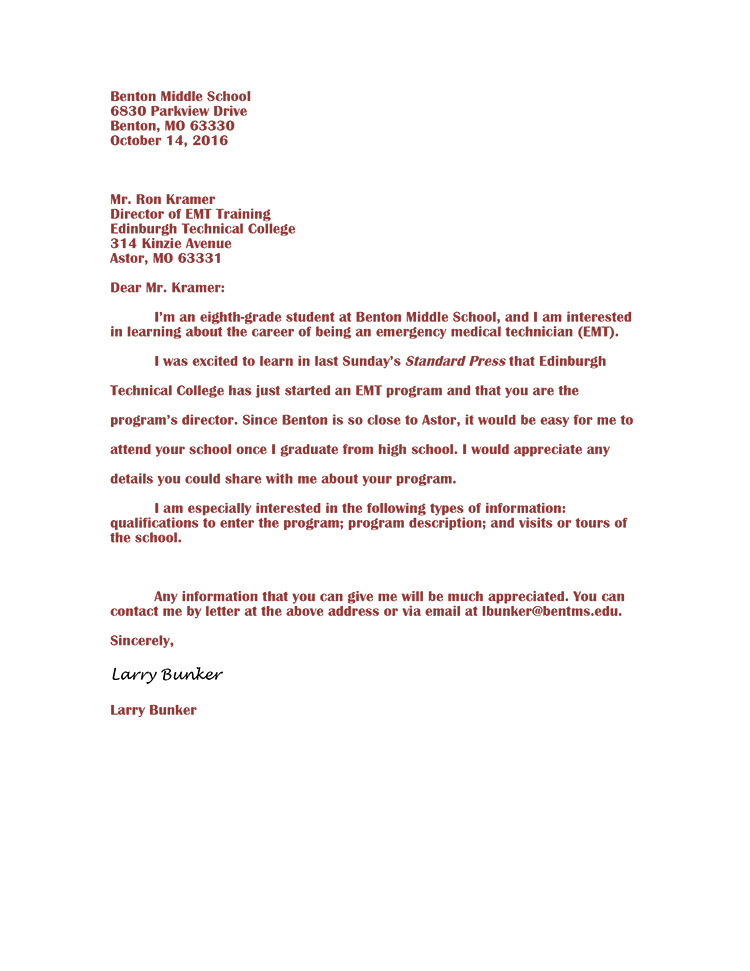
Design Flaw 1
Design Flaw 2
Design Flaw 3
Design Flaw 4
Design Flaw 5
Editing in Action
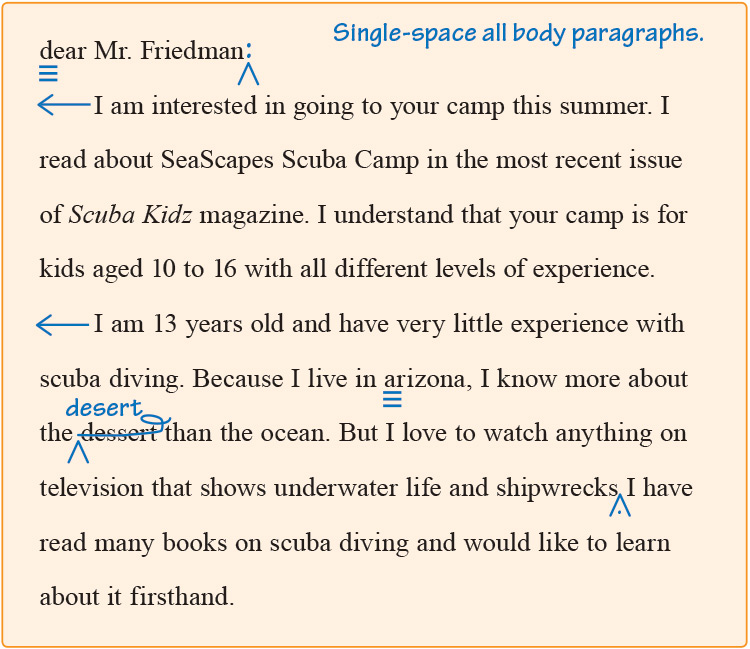
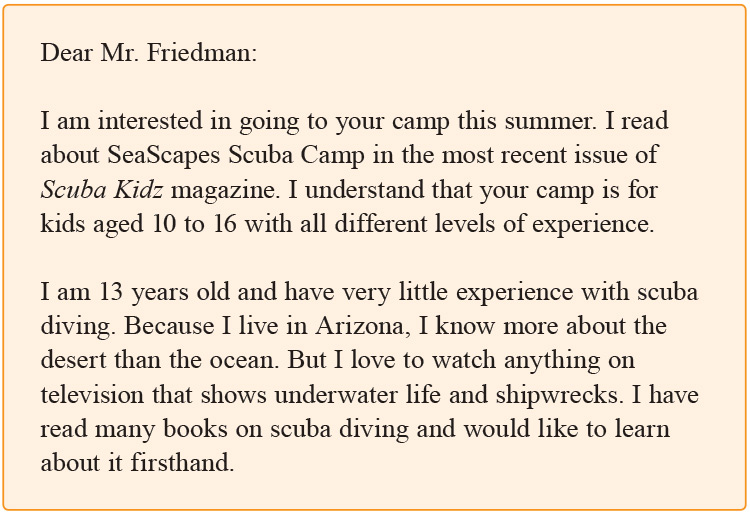
When you edit, you check to make sure your essay is correct.
Letter Before Edits
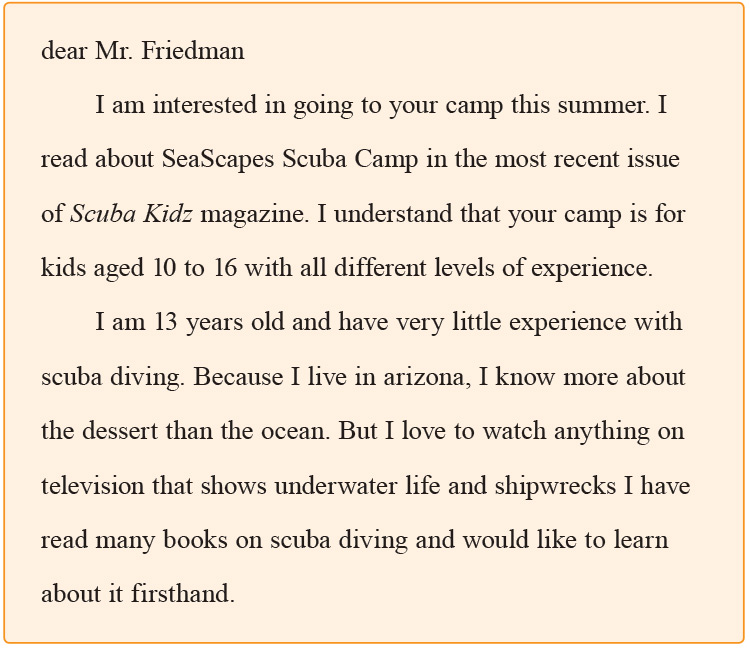
A usage error is fixed and a command sentence is created.
Letter After Edits
Edit with a checklist.
Read each line. When you can answer each question with a yes, check it off. Make a copy of this Google doc or download a Word template.
Punctuation
- Did I close each sentence with an end punctuation mark?
- Do commas follow four or more introductory words?
- Do I use a colon after the salutation?
Capitalization
- Did I start all sentences with capital letters?
- Did I capitalize the names of people and places?
- Did I capitalize the word "Dear" in the salutation and the first word in the closing (Yours truly,)?
Grammar
- Do my pronouns and antecedents agree? (All students need their own pencils.)
- Do the subjects and verbs agree in number? (Birds sing; David whistles.)
Usage
- Did I use an appropriate level of language?
- Did I correctly use commonly confused words (affect/effect)?
Spelling
- Did I check for spelling errors?
- Did I use a dictionary or the spell checker on my computer?

Publishing Application Letters
To publish your letter, you have to mail it to your reader. First, you need to make a clean final copy of your work. Then you need to fold it neatly and place it an envelope. Finally, write the correct address on the envelope and mail it for review.
Publishing a Final Copy
Create a final copy of your application letter.
Include your editing changes and read over your work a final time. (If you are working on a computer, spell check your work.) Make a copy of this Google doc or download a Word template.
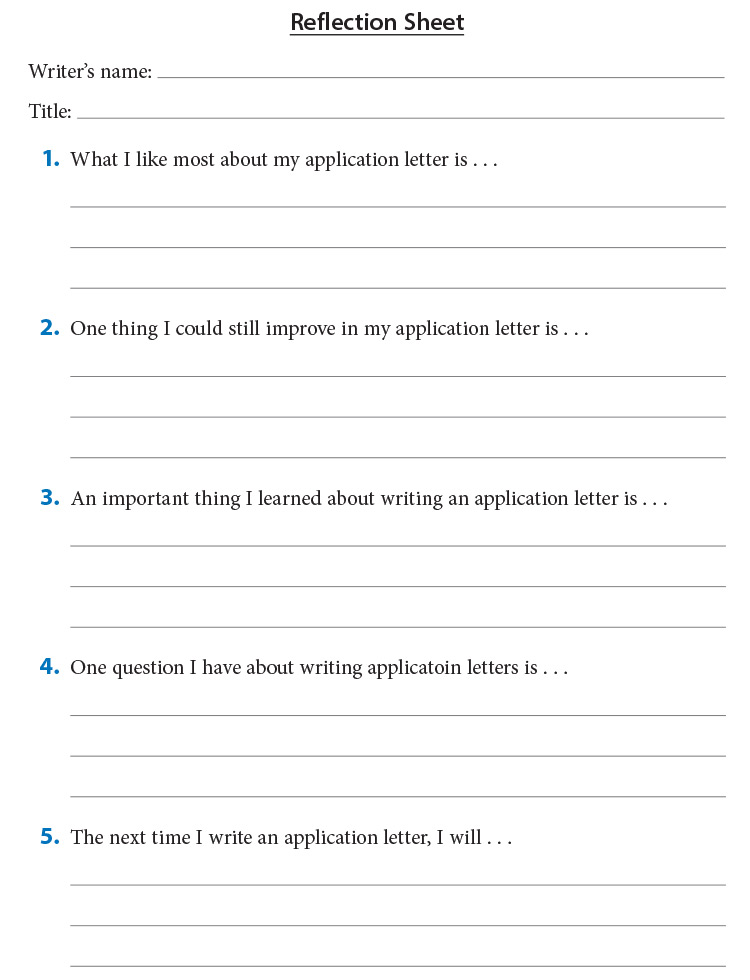
Reflecting on Your Writing
Reflect on your writing.
Complete the following form to think about what you learned. Make a copy of this Google doc or download a Word template.
Comments
Post a Comment